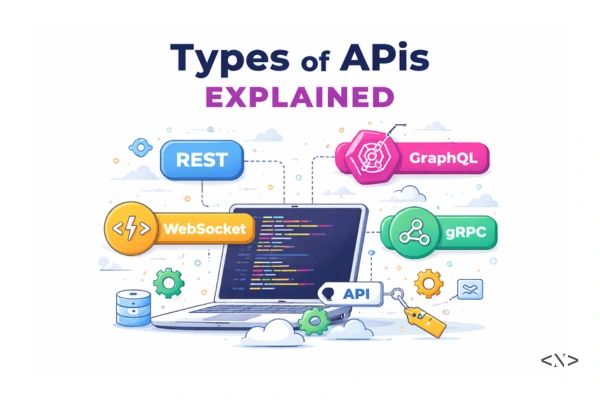
Types of APIs Explained for Web Developers in 2026: REST vs GraphQL vs gRPC and More
If you're building any modern web application --- authentication, payments, dashboards, or mobile apps --- you're using APIs.
Even if you don't realize it yet.
APIs are the bridge between frontend and backend. They allow different systems to communicate in a structured, predictable way.
But in 2026, developers don't use just one type of API.
You'll encounter:
- REST
- GraphQL
- gRPC
- WebSockets
- Webhooks
- Internal APIs
Each solves a different problem.
Understanding when to use each is what separates a beginner from a production-ready developer.
TL;DR (60 seconds)
- REST → Best default choice for most web apps\
- GraphQL → Best when frontend needs flexible data\
- gRPC → Best for microservices and high-performance systems\
- WebSockets → Best for real-time apps\
- Webhooks → Best for event-driven systems
If unsure, start with REST.
What Is an API?
API stands for Application Programming Interface.
In simple terms:
An API allows one program to talk to another.
Example:
GET /api/user/123
Response:
1{
2  "id": 123,
3  "name": "Adil",
4  "email": "adil@example.com"
5}
1. REST API
REST is the most widely used API architecture.
Example endpoints:
GET /api/products
POST /api/orders
DELETE /api/users/123
REST uses HTTP methods and JSON responses.
Pros
- Simple
- Easy to learn
- Industry standard
- Works everywhere
Cons
- Can overfetch data
- Less flexible than GraphQL
2. GraphQL
GraphQL allows frontend to request only needed data.
Example:
1query {
2  user(id: 123) {
3    name
4    email
5  }
6}
Pros
- Flexible
- Efficient
- Reduces requests
Cons
- More complex
- Harder caching
3. gRPC
gRPC is designed for high performance.
Uses:
- Protocol Buffers
- HTTP/2
- Binary format
Pros
- Extremely fast
- Efficient
- Ideal for microservices
Cons
- Not browser friendly
- Harder setup
4. WebSockets
WebSockets enable real-time communication.
Used for:
- Chat apps
- Live notifications
- Real-time dashboards
5. Webhooks
Webhooks send data automatically when events happen.
Example:
- Payment completed
- User signed up
Comparison Table
| Feature | REST | GraphQL | gRPC |
|---|---|---|---|
| Learning curve | Easy | Medium | Hard |
| Performance | Good | Good | Excellent |
| Flexibility | Medium | High | High |
| Browser support | Excellent | Excellent | Limited |
What Developers Use in 2026
Most apps use:
- REST for main APIs
- WebSockets for realtime
- Webhooks for integrations
Large companies may use GraphQL and gRPC internally.
Final Thoughts
APIs are fundamental to modern development.
Start with REST.
Then learn GraphQL and gRPC when needed.
Mastering APIs unlocks backend development and system design.
GitHub Discussions
Discuss this article