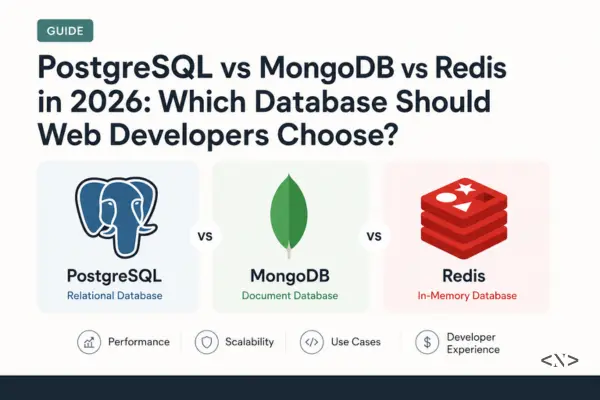
PostgreSQL vs MongoDB vs Redis in 2026: Which Database Should Web Developers Choose?
Choosing a database has become strangely noisy.
One developer says PostgreSQL should be the default for almost every serious application. Another says MongoDB is easier because you can store data as documents. Someone else says Redis is extremely fast and should be used everywhere.
All three statements can be true in the right context. They can also be dangerous when repeated without context.
The real question is not "Which database is best?"
The better question is:
What job does this database need to perform in your system?
In 2026, most production web applications are not choosing between PostgreSQL, MongoDB, and Redis as if only one can exist. They often use them together:
- PostgreSQL as the primary system of record
- Redis for caching, sessions, queues, rate limits, and short-lived state
- MongoDB when the data model is naturally document-shaped and changes often
This guide explains how to think about that choice clearly.
If you are new to databases, start with the broader types of databases guide. If you already understand the basics and want a decision framework, this article is for you.
Quick Answer
For most web applications in 2026:
| Use case | Best first choice |
|---|---|
| SaaS app | PostgreSQL |
| Ecommerce app | PostgreSQL |
| Admin dashboard | PostgreSQL |
| User accounts and billing | PostgreSQL |
| Blog, CMS, content platform | PostgreSQL or MongoDB |
| Highly flexible nested documents | MongoDB |
| Cache layer | Redis |
| Session storage | Redis |
| Rate limiting | Redis |
| Queues and background jobs | Redis or a dedicated queue |
| Real-time counters | Redis |
| Main permanent database | Usually not Redis |
If you are building a normal web app and do not have a strong reason to choose otherwise, start with PostgreSQL.
That does not mean MongoDB is bad. It does not mean Redis is optional forever. It means PostgreSQL handles the widest set of common production requirements with the fewest surprises.
The Mistake Beginners Make
Many beginners choose a database by asking:
- Which one is fastest?
- Which one is easiest?
- Which one is most popular?
- Which one are companies using?
Those questions are understandable, but incomplete.
A better database decision considers:
- How your data is structured
- How often the shape of that data changes
- Whether relationships matter
- Whether you need transactions
- How you query the data
- How you scale reads and writes
- How painful mistakes will be later
- Whether the database is the source of truth or just a supporting layer
This is why Redis can be incredibly fast and still be the wrong primary database for your app. It is why MongoDB can feel flexible at the beginning and still become difficult if your data becomes relational. It is also why PostgreSQL can look boring and still be the best decision you make.
Production systems reward boring decisions when those decisions keep data safe, queryable, and understandable.
PostgreSQL: The Best Default for Most Web Apps
PostgreSQL is a relational database. It stores data in tables with rows, columns, constraints, indexes, relationships, and transactions.
That sounds traditional, but it is exactly what most web applications need.
Most apps are built around entities and relationships:
- Users create posts
- Customers place orders
- Orders contain products
- Teams have members
- Projects have tasks
- Invoices belong to accounts
- Comments belong to articles
This is relational data. PostgreSQL is built for it.
Why PostgreSQL Works So Well
PostgreSQL gives you:
- Strong data consistency
- SQL queries
- Foreign keys
- Transactions
- Indexes
- Joins
- JSON support
- Full-text search options
- Extensions
- Mature tooling
The important part is not just feature count. The important part is that PostgreSQL lets you model important business data with structure and rules.
For example, if every order must belong to a real customer, the database can enforce that. If an email must be unique, the database can enforce that. If payment creation and invoice creation must succeed together, transactions can protect that workflow.
These guarantees matter more as your app grows.
When PostgreSQL Should Be Your First Choice
Choose PostgreSQL when:
- Your data has relationships
- You need reliable transactions
- You care about reporting and analytics
- You want strong constraints
- You expect the app to grow over time
- You are building SaaS, ecommerce, dashboards, internal tools, finance tools, or productivity apps
PostgreSQL is also a strong choice when you are not sure what the future data access patterns will be. SQL gives you a lot of flexibility later.
That flexibility is underrated.
PostgreSQL Example
Imagine a simple project management app:
- A user belongs to an organization
- An organization has projects
- A project has tasks
- A task has comments
- A comment belongs to a user
This is exactly where PostgreSQL shines.
You can model the relationships clearly:
1SELECT tasks.id, tasks.title, users.name AS assignee
2FROM tasks
3JOIN users ON users.id = tasks.assignee_id
4WHERE tasks.project_id = $1
5ORDER BY tasks.created_at DESC;
The data is structured, queryable, and easy to reason about.
If performance becomes a problem later, you can improve it with indexes, query planning, and pagination. I covered that in more detail in the database indexing guide and the guide on N+1 queries and pagination.
MongoDB: Great When Your Data Is Document-Shaped
MongoDB is a document database. Instead of rows and tables, it stores documents that look similar to JSON objects.
That makes it feel natural for JavaScript developers because the database shape often resembles the objects used in the application code.
A MongoDB document might look like this:
1{
2  "title": "Database Design Notes",
3  "author": {
4    "name": "Nested Dev",
5    "handle": "nesteddev"
6  },
7  "tags": ["database", "backend", "architecture"],
8  "sections": [
9    {
10      "heading": "Indexes",
11      "position": 1
12    },
13    {
14      "heading": "Query Patterns",
15      "position": 2
16    }
17  ]
18}
This can be convenient when the whole object is usually read and written together.
Where MongoDB Feels Strong
MongoDB works well when:
- Your data is naturally nested
- The schema changes frequently
- You do not need many joins
- You read whole documents at once
- Your app stores content, event data, product configurations, logs, or flexible profiles
For example, a content management system might allow different article blocks:
- Paragraph
- Code block
- Image
- Callout
- Table
- Embed
Each article may have a different structure. In that case, storing the article as a document can make sense.
Where MongoDB Can Become Difficult
MongoDB becomes harder when your data is deeply relational.
For example:
- Users join teams
- Teams own projects
- Projects contain tasks
- Tasks have comments
- Comments have reactions
- Permissions depend on roles
- Billing depends on organization state
You can model this in MongoDB, but you must be careful. If you embed too much, updates become awkward. If you reference too much, you start manually rebuilding relationships that relational databases already understand well.
The beginner mistake is using MongoDB because it feels easy on day one, then discovering that the application needs relational behavior on day one hundred.
MongoDB is not bad. It simply rewards a different data model.
When MongoDB Should Be Your First Choice
Choose MongoDB when:
- Documents are the natural unit of your app
- Records can contain different fields
- Your product needs flexible schemas
- You mostly read and write complete documents
- You can avoid complex joins
MongoDB can be a good choice for:
- CMS platforms
- Product catalogs with flexible attributes
- Event storage
- User-generated content
- Prototypes with changing requirements
- Apps where nested documents are central
But if your app is mostly users, teams, permissions, orders, invoices, subscriptions, and reports, PostgreSQL is usually a safer first choice.
Redis: Fast, Useful, and Often Misunderstood
Redis is an in-memory data store. It is famous for speed because it keeps data in memory and supports simple, efficient data structures.
Redis can be used for:
- Caching
- Sessions
- Rate limiting
- Queues
- Pub/sub
- Counters
- Temporary tokens
- Leaderboards
- Real-time coordination
Redis is excellent as a supporting system. It is usually not the first database you should use as the permanent source of truth for a normal web app.
Redis as a Cache
Imagine your app has an expensive database query:
1SELECT *
2FROM articles
3WHERE category = 'Database'
4ORDER BY published_at DESC
5LIMIT 10;
If this query runs thousands of times per hour and the result does not change every second, Redis can cache the response.
The flow becomes:
- Check Redis for cached data
- If found, return it quickly
- If missing, query PostgreSQL
- Store the result in Redis for a short time
- Return the result
This reduces database load and improves response time.
Redis for Rate Limiting
Redis is also great for rate limiting because it can increment counters quickly.
For example:
- Allow 100 API requests per user per minute
- Store the count in Redis
- Expire the counter after 60 seconds
- Block requests after the limit
This kind of short-lived operational state is exactly where Redis fits.
Redis for Sessions
If you need session storage across multiple servers, Redis is a common option.
Instead of storing session data on one server, you store it in Redis so any server can access it. This works well for horizontally scaled applications.
When Redis Should Be Your First Choice
Choose Redis when the data is:
- Temporary
- Frequently accessed
- Simple in shape
- Performance-sensitive
- Safe to rebuild from another source
Do not choose Redis as your main permanent database unless you deeply understand the durability, persistence, memory, backup, and operational trade-offs.
For most web developers, Redis is the performance layer, not the system of record.
How They Work Together in a Real App
A production SaaS app might use all three technologies, but each one has a different job.
Example architecture:
- PostgreSQL stores users, teams, projects, subscriptions, invoices, and permissions
- Redis stores sessions, cache entries, rate limit counters, and background job state
- MongoDB stores flexible customer-created templates or document-like content
The key idea is ownership.
Every piece of data should have a clear owner:
- Permanent business data: PostgreSQL
- Flexible document data: MongoDB
- Fast temporary state: Redis
Problems begin when ownership is unclear.
If the same important data exists in PostgreSQL and MongoDB and Redis without clear rules, debugging becomes painful. Which one is correct? Which one updates first? What happens when one update succeeds and another fails?
The more systems you add, the more discipline you need.
Start simple. Add another database only when it solves a real problem.
Decision Framework
Use this framework before choosing.
1. Is the Data Relational?
Ask:
- Does this data connect to other data?
- Do I need joins?
- Do I need constraints?
- Do I need transactions?
If yes, choose PostgreSQL.
2. Is the Data Document-Shaped?
Ask:
- Do I usually read the whole object at once?
- Does the object contain nested fields?
- Do records vary in structure?
- Would forcing this into tables feel unnatural?
If yes, consider MongoDB.
3. Is the Data Temporary or Performance-Oriented?
Ask:
- Can this data expire?
- Can it be rebuilt?
- Is it used for cache, sessions, or rate limits?
- Is speed more important than long-term querying?
If yes, consider Redis.
4. What Happens If the Database Is Wrong?
This is the most important question.
If losing or corrupting the data would break the business, use a durable primary database with strong consistency guarantees.
That usually means PostgreSQL.
If the data is a cache and can be recreated, Redis is fine.
If the data is flexible content and document structure matters more than relational joins, MongoDB may be appropriate.
Common Beginner Mistakes
Mistake 1: Choosing MongoDB Only Because It Looks Like JSON
JSON-like documents are comfortable, especially for JavaScript developers. But comfort is not the same as long-term fit.
If your app needs relationships, reporting, transactions, and constraints, PostgreSQL may save you from future pain.
Mistake 2: Using Redis as the Main Database Too Early
Redis is fast, but speed is not the only database requirement.
Durability, querying, backups, memory cost, and operational simplicity matter. Use Redis when its strengths match the job.
Mistake 3: Ignoring Indexes
The right database can still become slow without the right indexes.
If your query filters by user_id and sorts by created_at, the database needs an index that supports that access pattern. Otherwise, performance will degrade as data grows.
Read the database indexing guide before your app becomes slow.
Mistake 4: Thinking One Database Must Do Everything
Small apps should usually start with one database. But mature systems often use different storage tools for different jobs.
The danger is not using multiple databases. The danger is using them without clear boundaries.
Mistake 5: Choosing Based on Hype
Database decisions should come from data shape and access patterns, not social media arguments.
Ask what your app actually needs.
Practical Examples
Example 1: SaaS Dashboard
Use PostgreSQL.
You likely need users, teams, roles, permissions, subscriptions, invoices, settings, audit logs, and reports. These are relational and business-critical.
Add Redis later for caching dashboards, storing sessions, and rate limiting API requests.
Example 2: Ecommerce Store
Use PostgreSQL.
Products, customers, carts, orders, payments, refunds, inventory, and shipping records need consistency. Transactions matter.
MongoDB may be useful for flexible product metadata, but PostgreSQL should usually own the core business data.
Example 3: Content Platform
Use PostgreSQL or MongoDB depending on structure.
If articles, authors, categories, permissions, and workflows are central, PostgreSQL works well.
If each content item has highly flexible nested blocks and custom fields, MongoDB can be a good fit.
Example 4: Real-Time Chat App
Use PostgreSQL for users, channels, memberships, and message history.
Use Redis for presence, typing indicators, pub/sub, and short-lived real-time state.
Example 5: Analytics Dashboard
It depends.
PostgreSQL can handle many analytics needs at small and medium scale. At larger scale, you may need a dedicated analytics database or warehouse.
Do not start with a complicated analytics stack before your product has real usage.
Final Recommendation
If you are building your next web app in 2026 and you are unsure which database to choose, use this rule:
Start with PostgreSQL as your primary database. Add Redis when you have a clear caching, session, queue, or rate-limit need. Choose MongoDB when your core data is genuinely document-shaped.
This approach is boring in the best possible way.
It keeps your system understandable. It gives you strong guarantees for important data. It lets you improve performance later without redesigning everything too early.
Good architecture is not about using the most exciting tool. It is about choosing the tool whose trade-offs match the job.
PostgreSQL, MongoDB, and Redis are all excellent when used for the right reason.
The senior decision is knowing which problem each one is supposed to solve.
Frequently Asked Questions
Should I choose PostgreSQL or MongoDB for a new web app?
Choose PostgreSQL for most new web apps, especially when your data has relationships, transactions, constraints, reporting, or billing. Choose MongoDB when your core data is naturally document-shaped, flexible, and usually read or written as a whole document.
Is Redis a replacement for PostgreSQL or MongoDB?
Redis is usually not a replacement for PostgreSQL or MongoDB. It is best used for caching, sessions, rate limits, queues, counters, and short-lived operational state. For permanent business data, most apps should use a durable primary database.
Can PostgreSQL, MongoDB, and Redis be used together?
Yes. Many production systems use PostgreSQL as the primary database, Redis for performance-sensitive temporary state, and MongoDB only where flexible document storage is genuinely useful. Each database should have a clear responsibility.
GitHub Discussions
Discuss this article