Database Indexing Explained for Web Developers (Complete Guide)
If you have ever built a web application and noticed that database queries become slower as data grows, you have already encountered the exact problem that database indexing is meant to solve.
This article is a professional, end-to-end guide to database indexing, written specifically for web developers. It explains what indexing is, how it works internally, its advantages and disadvantages, and how it behaves in real production systems.
The focus is practical understanding, not academic theory.
If you haven’t read my previous articles, I recommend starting with our Database Roadmap for Web Developers
What Is Database Indexing?
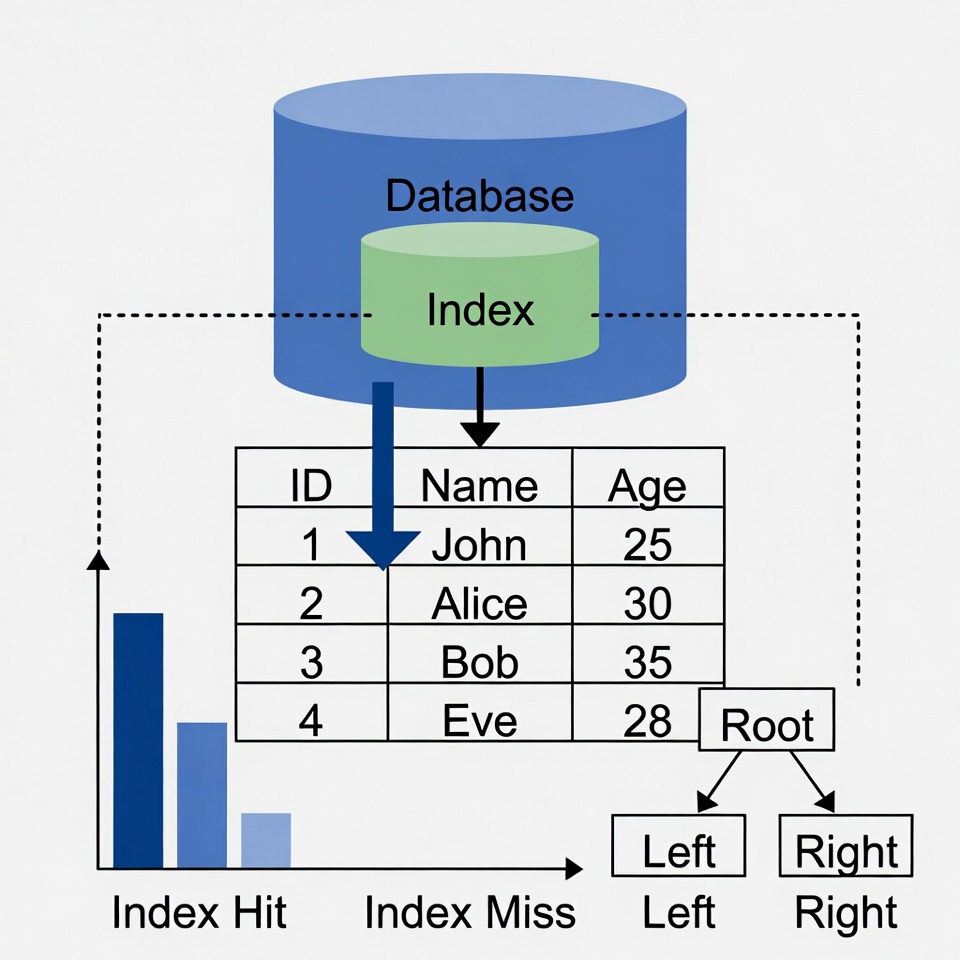
A database index is a data structure that allows the database engine to locate rows efficiently without scanning the entire table.
Without an index, the database must inspect every row to find matching data. With an index, the database can jump directly to the required rows.
Conceptual Analogy
- Without an index: reading every page of a book to find a topic
- With an index: using the book’s index to reach the exact page
Indexes exist to reduce unnecessary work during query execution.
Why Queries Become Slow Without Indexes
Consider a table that grows over time:
- Hundreds of rows: fast
- Thousands of rows: acceptable
- Millions of rows: slow without indexing
When no index exists, the database performs a full table scan, meaning:
- Every row is examined
- Conditions are evaluated row by row
- CPU and memory usage increase
This approach does not scale.
How Database Indexing Works Internally
Most relational databases such as PostgreSQL and MySQL use B-Tree structures for indexes.
Key properties:
- Data is stored in a sorted structure
- Lookups work in logarithmic time complexity
- The database traverses a small portion of the tree instead of the entire table
Visualization: Table Scan vs Indexed Lookup
1graph TD
2    A[Query Request] --> B[Full Table Scan]
3    B --> C[Row 1]
4    B --> D[Row 2]
5    B --> E[Row N]
6
7    A --> F[Index Lookup]
8    F --> G[Matching Rows]
9
This is why indexing dramatically improves read performance.
Example: Query Without an Index
1SELECT * FROM users WHERE email = 'test@nesteddev.top';
2
If the email column is not indexed:
- Every row in the
userstable is checked - Performance degrades as data grows
Same Query With an Index
1CREATE INDEX idx_users_email ON users(email);
2
Now the database:
- Uses the index to locate rows
- Avoids scanning unrelated data
- Returns results significantly faster
This is why columns such as email, username, and IDs are commonly indexed.
Real-World Scenario: E-Commerce Application
Imagine an e-commerce platform with:
- 1 million products
- 10 million orders
- Frequent filtering by category, price, and availability
Common Query
1SELECT * FROM products
2WHERE category = 'Sneakers'
3AND price < 3000;
4
Optimized With a Composite Index
1CREATE INDEX idx_products_category_price
2ON products(category, price);
3
Visualization: Composite Index Usage
1graph TD
2    A[Category Filter] --> B[Composite Index]
3    C[Price Filter] --> B
4    B --> D[Filtered Products]
5
Result:
- Faster product listings
- Lower database load
- Better user experience
Common Types of Database Indexes
Primary Index
- Automatically created on primary keys
- Always unique
1PRIMARY KEY (id)
2
Unique Index
- Prevents duplicate values
- Commonly used for emails and usernames
1CREATE UNIQUE INDEX idx_users_email ON users(email);
2
Composite Index
- Covers multiple columns
- Column order matters
1CREATE INDEX idx_orders_user_date
2ON orders(user_id, created_at);
3
Effective when queries filter by both columns together.
Partial Index
Indexes only a subset of rows.
1CREATE INDEX idx_active_users
2ON users(email)
3WHERE is_active = true;
4
Useful for large tables with predictable query patterns.
Indexing in NoSQL Databases
Indexing is not limited to SQL databases.
Example in MongoDB:
1db.users.createIndex({ email: 1 })
2
Without indexes, MongoDB also performs full collection scans.
Indexes are essential regardless of database type.
Advantages of Database Indexing
- Faster read queries
- Improved application responsiveness
- Reduced CPU and memory usage
- Essential for scalable systems
Disadvantages of Database Indexing
Slower Write Operations
Every insert, update, or delete must also update all related indexes.
More indexes directly increase write cost.
Increased Storage Usage
Indexes consume disk space. Large tables with many indexes increase storage requirements.
Over-Indexing Risks
Excessive indexing can:
- Slow down writes significantly
- Complicate query planning
- Increase maintenance overhead
Indexes should always be added intentionally.
Read vs Write Performance Trade-Off
A fundamental rule of databases:
Indexes improve read performance but reduce write performance.
Read-Heavy Systems
- Blogs
- Product catalogs
- Dashboards
Write-Heavy Systems
- Chat applications
- Event logging
- Analytics ingestion pipelines
Write-heavy systems require careful and minimal indexing.
When Should You Add an Index?
Add an index when:
- Queries are slow and frequent
- Columns are used in WHERE, JOIN, or ORDER BY clauses
- Table size is large or growing
Avoid indexing:
- Very small tables
- Columns rarely used in queries
- Columns with very low selectivity
Detecting Missing Indexes
Using EXPLAIN
1EXPLAIN ANALYZE SELECT * FROM users WHERE email = 'x';
2- Sequential scan indicates possible missing index
- Index scan indicates proper usage
Indexing with Prisma ORM
1model User {
2  id    String @id @default(uuid())
3  email String @unique
4}
5
Prisma automatically creates indexes for primary and unique fields.
Composite indexes can be defined explicitly:
1@@index([userId, createdAt])
2
Common Indexing Mistakes
- Indexing every column
- Ignoring write performance
- Not reviewing unused indexes
- Misordering columns in composite indexes
Indexes require periodic review as applications evolve.
Final Thoughts
Database indexing is a performance optimization technique built on trade-offs.
When used correctly, applications scale efficiently. When used blindly, systems suffer from unnecessary complexity and slow writes.
For web developers, understanding indexing is not optional. It is a core production skill.
In the next article, we will explore query optimization and pagination strategies, which naturally build on indexing fundamentals.