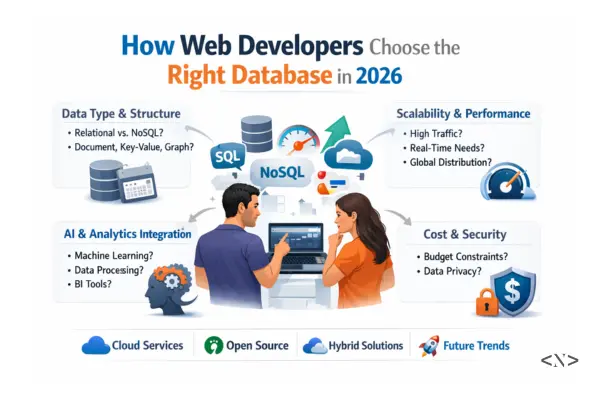
How Web Developers Choose the Right Database in 2026
Choosing a database in 2026 is no longer about SQL vs NoSQL.
It’s about trade-offs, workload patterns, cost, scaling model, and long-term maintainability.
With managed databases, serverless platforms, and cloud-native tooling becoming the default, the real question web developers ask today is:
Which database will let me ship fast now — without killing me later?
This guide breaks down how experienced web developers actually choose databases in 2026, without hype, vendor bias, or misleading shortcuts. If you're new to databases, check out my Database Roadmap for Web Developers in 2026 for a step-by-step learning path.
The biggest mistake developers still make
The most common mistake is choosing a database based on:
- Trends on Twitter
- What a YouTube tutorial used
- “This company uses it at scale”
- Fear of SQL or fear of NoSQL
In reality, most production issues are caused by poor data modeling and wrong assumptions, not by the database engine itself.
The modern default: Why PostgreSQL still dominates
In 2026, PostgreSQL is the default starting point for most web applications — and for good reason.
Why Postgres works for most apps
- Strong ACID guarantees
- Mature indexing and query planner
- JSONB support (hybrid SQL + NoSQL)
- Rich ecosystem (Prisma, Drizzle, TypeORM)
- Easy migration paths
- Works well with managed platforms (Supabase, Neon, RDS)
When Postgres is the right choice
Choose PostgreSQL if:
- Your data has relationships (users, orders, permissions)
- You need transactions (payments, inventory, workflows)
- You expect reporting or analytics later
- You want portability and less vendor lock-in
Most SaaS products, internal tools, dashboards, and APIs should start here.
MongoDB: Flexible, but not free
MongoDB is often chosen for “flexibility”, but flexibility has a cost.
Where MongoDB shines
- Document-heavy data
- Rapidly evolving schemas
- Nested JSON structures
- Content-heavy platforms
Hidden trade-offs
- Data duplication is common
- Complex joins are painful
- Transactions exist, but are not the default mental model
- Poor schema discipline causes long-term issues
MongoDB works best when:
- Your data is truly document-first
- You control write patterns
- You accept denormalization intentionally
Redis is not a database (but you still need it)
Redis is not a primary database, but it is a critical component in modern stacks.
Common Redis use cases
- Caching expensive queries
- Session storage
- Rate limiting
- Real-time counters
- Pub/Sub and queues
Redis should almost always be paired with:
- PostgreSQL or MongoDB as source of truth
Serverless databases: convenience vs control
Serverless-first databases exploded due to platforms like Vercel, Cloudflare, and AWS Lambda.
Popular options in 2026
Why developers choose them
- No connection management
- Automatic scaling
- Pay-per-use pricing
- Zero ops
Why they hesitate
- Vendor lock-in
- Eventual consistency
- Limited query flexibility
- Complex data modeling (single-table design)
Serverless databases are best when:
- Traffic is highly spiky
- You need massive horizontal scaling
- You can design around constraints
NewSQL: bridging SQL and scale
NewSQL databases aim to solve Postgres-at-scale problems.
Examples
What they offer
- SQL interface
- Distributed transactions
- Global replication
The reality
- Higher cost
- More operational complexity
- Overkill for most startups
Use NewSQL only when:
- You need global consistency
- You have real scale, not anticipated scale
How experienced developers actually decide
Here’s the real decision flow used in production teams:
1. Define the data shape
- Relational? → SQL
- Document-heavy? → MongoDB
- Key-value? → Redis / DynamoDB
2. Decide consistency needs
- Money, permissions, workflows → Strong consistency
- Likes, views, analytics → Eventual consistency
3. Understand access patterns
- Complex queries → PostgreSQL
- Simple reads by key → NoSQL
4. Evaluate hosting model
- Server-based → Traditional DBs work well
- Serverless → Connection-friendly databases matter
5. Plan for migrations early
No database choice is permanent. Plan for:
- Schema migrations
- Data exports
- Backup and restore testing
Real-world database stacks (2026)
Typical SaaS application
- PostgreSQL (primary DB)
- Redis (cache + sessions)
- Object storage (files)
Content platform
- PostgreSQL or MongoDB
- Redis
- Search engine (OpenSearch / Meilisearch)
High-scale serverless app
- DynamoDB or PlanetScale
- S3 / R2
- Edge caching
Analytics-heavy product
- PostgreSQL (OLTP)
- ClickHouse / BigQuery (OLAP)
Deep concepts developers must understand
Connection pooling
Serverless functions can easily exhaust DB connections. Solutions:
- PgBouncer
- Serverless DB proxies
- HTTP-based DB APIs
Indexing strategy
Indexes speed reads but slow writes. Bad indexing is worse than no indexing.
Cost modeling
Most teams underestimate:
- Egress costs
- Backup storage
- Read amplification
Observability
Track:
- Slow queries
- Connection usage
- Replication lag
- Cache hit rates
A simple rule of thumb
If you don’t know which database to choose, start with PostgreSQL.
Add other databases only when:
- A clear bottleneck exists
- You understand the operational cost
- The benefit is measurable
Final thoughts
There is no perfect database in 2026.
There is only:
- A correct trade-off
- A clear understanding of your workload
- A willingness to adapt as the product grows
The best web developers don’t chase database trends —
they design systems that evolve without breaking.
Suggested follow-up articles
- PostgreSQL vs MongoDB: Real Production Trade-offs
- SQL vs NoSQL with Real Examples
- Why Most Startups Don’t Need Microservices
- How Serverless Changes Database Design
Happy building. Choose boring tech wisely.