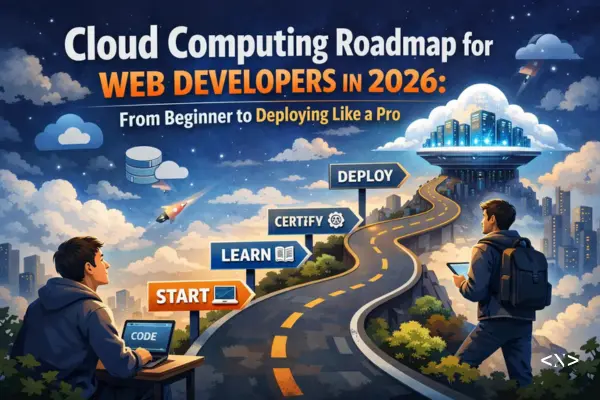
Cloud Computing Roadmap for Web Developers in 2026: From Beginner to Deploying Like a Pro
If you’ve already started your web development journey (like building portfolios, React apps, or Next.js projects as covered in my earlier post, refere my Want to Start a Career as a Web Developer in 2026), the next logical step is learning how to deploy and scale those applications properly. That’s where cloud computing becomes your best friend. But yes, do take enough knowledge in development first.
In 2026, almost every serious web developer needs at least basic cloud knowledge. Companies expect you to understand deployment pipelines, serverless options, cloud storage, and databases — even for junior roles.
This roadmap was created especially for web developers in their early stages. No heavy DevOps theory — just practical, hands-on steps to get cloud-ready fast.
Why Cloud Skills Matter for Web Developers in 2026
Deployment is no longer “nice to have”.
Modern web apps need:
- Fast global delivery (CDN)
- Automatic scaling
- Secure backend services
- Cost-effective hosting
- Easy CI/CD from GitHub or for a little complex one if needed then Jenkins.
Whether you want to freelance, land a full-stack job, or build side projects that thousands of people use — cloud is the bridge between “it works on my machine” and “it works for everyone”.
Cloud Computing Roadmap 2026 – Step by Step
Phase 1: Understand the Big Picture (1–2 weeks)
Goal: Know what “cloud” actually means for developers.
Learn these core concepts (in simple terms):
- IaaS, PaaS, SaaS → Infrastructure, Platform, Software as a Service
- Public vs Private vs Hybrid Cloud
- Serverless → You don’t manage servers anymore
- Containers → Lightweight way to package apps (Docker basics)
- CDN → Why your images load fast worldwide
Best free resources in 2026:
- AWS “Cloud Practitioner Essentials” (free digital training)
- Google Cloud “Cloud Digital Leader” intro course
- YouTube: Any authentic youtube videos.
No need to memorize — just understand the “why” behind each term.
Phase 2: Pick Your First Cloud Platform (2–4 weeks)
Recommendation for web developers in 2026:
| Priority | Platform | Best For | Learning Curve | Free Tier Strength |
|---|---|---|---|---|
| 1 | Vercel | Next.js, frontend-heavy apps | Very easy | Excellent |
| 2 | Netlify | Static sites, Jamstack, functions | Very easy | Excellent |
| 3 | AWS | Full flexibility, backend, databases | Medium | Very good |
| 4 | Railway.app | Simple full-stack deploys | Easy | Good |
| 5 | Fly.io | Docker-based global apps | Medium | Good |
Action plan:
- Create accounts on Vercel and AWS (free tiers)
- Deploy your existing Next.js portfolio to Vercel in < 5 minutes
- Push the same repo to Netlify — compare the experience
Most developers start here and never leave Vercel/Netlify for side projects.
Phase 3: Master Deployment & Hosting (4–6 weeks)
Focus areas:
- Deploy static sites (HTML/CSS/JS or Next.js export)
- Deploy full-stack Next.js apps (App Router + server actions)
- Use environment variables securely
- Custom domains + HTTPS (automatic on most platforms)
- Preview deployments / branch previews
- Rollbacks
Projects to build & deploy:
- Personal blog (like this one!) → Vercel
- Todo app with authentication (especially the backend) → Railway or Render
- E-commerce frontend clone → Netlify + serverless functions
Phase 4: Add Cloud Databases & Storage (4–8 weeks)
Every real app needs persistent data.
Start with these beginner-friendly options:
- Supabase or PlanetScale → PostgreSQL (easiest for JS devs)
- MongoDB Atlas → NoSQL, generous free tier
- Firebase → Realtime DB + Auth (great for MVPs)
- AWS S3 → File storage (images, PDFs, user uploads)
- Cloudinary → File storage (images, PDFs, user uploads)
Mini-project ideas:
- Build a simple image upload app → Next.js + S3/Cloudinary
- Create a guestbook app → Next.js + Supabase
Phase 5: Serverless & Edge (optional – Level up)
Once comfortable:
- Serverless functions (Vercel Functions, Netlify Functions, AWS Lambda)
- Edge middleware (Next.js middleware on edge)
- Caching strategies (CDN + stale-while-revalidate)
Phase 6: Portfolio & Career Boost
Showcase cloud knowledge:
- Add “Deployed on Vercel / AWS” badges
- Write deployment guides in your READMEs
- Record short Loom videos showing one-click deploy
- Mention cloud platforms in your resume & LinkedIn
Certifications that actually help in 2026 (optional but respected):
- AWS Certified Cloud Practitioner
- Google Cloud Associate Cloud Engineer
- (Vercel / Netlify don’t have certs — real projects matter more)
Quick 2026 Cloud Keywords to Target
When writing your own blog posts or optimizing your portfolio:
- cloud deployment for web developers
- best cloud platform for Next.js 2026
- serverless for beginners
- deploy Next.js app to Vercel step by step
- free cloud database for web apps
Final Thoughts
You don’t need to become a DevOps engineer overnight.
Start small: deploy your next project to Vercel or Netlify this weekend.
Then gradually add a real database, file storage, and serverless logic.
Note: If you are in the early stages of learning, DO NOT SPEND MONEY ON CLOUD if you are not confident enough.
Cloud skills separate “I built something cool locally” from “I shipped a real product people use”.
If you’re coming from my earlier posts on web development careers — this is the natural next chapter.
What’s the first app you plan to deploy to the cloud?
Let me know in the comments — I’d love to cheer you on!